
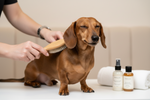
How to Groom a Dachshund: Complete Grooming Guide
, 37 min reading time
, 37 min reading time
A complete Dachshund grooming guide covering Smooth, Longhaired and Wirehaired coats, brushing, bathing, nails, ears, hand-stripping, home care and back-safe grooming from puppyhood to senior age.
Dachshunds are often described as easy dogs to groom because they are small and many have short coats. That description is only partly true. A Smooth Dachshund may need relatively little coat maintenance, but the breed as a whole requires more thoughtful care than its size suggests.
The reason is simple: there is no single Dachshund grooming routine. Dachshunds come in three distinct coat varieties—Smooth, Longhaired and Wirehaired—and each one needs a different approach. Their coat characteristics are genuinely different rather than simply different hair lengths.
A Smooth Dachshund mainly needs shedding control, skin monitoring, bathing, nail care and ear hygiene. A Longhaired Dachshund needs those things plus regular brushing, detangling and attention to feathering. A Wirehaired Dachshund adds another level entirely because maintaining the traditional harsh coat may involve hand-stripping rather than simply clipping the hair.
And then there is the Dachshund's body structure.
Their long backs and short legs mean that grooming should not only make them clean. It should also be physically comfortable and back-conscious. Slippery surfaces, awkward lifting, uncontrolled jumping from grooming tables and unnecessarily long standing sessions deserve more attention than they might with many other breeds.
This guide explains how to groom a Dachshund from puppyhood into old age, how grooming changes between the three coat types, what can be done at home, where professional grooming becomes valuable, and how to build a routine that keeps the dog clean without turning grooming into a struggle.
A well-maintained Dachshund should feel clean, comfortable and easy to handle. The goal is not to over-groom the dog or create a highly artificial finish. It is to keep the coat functioning properly, the nails at a sensible length, the ears clean, the mouth monitored and the dog comfortable during every part of the routine.
Because Dachshunds come in Smooth, Longhaired and Wirehaired varieties, owners should resist copying a routine from another Dachshund without first considering coat type. The breed also comes in different sizes, but coat variety usually makes the greatest difference to the grooming technique itself.
The main areas of Dachshund grooming include:
A grooming routine becomes much easier when these tasks are divided into small, regular sessions instead of being left until the dog needs a complete overhaul.
The Smooth Dachshund has the simplest coat from a grooming perspective. The coat is short, close to the body and naturally sleek. It should feel smooth rather than fluffy or heavily textured.
That simplicity sometimes causes owners to neglect brushing altogether. Smooth Dachshunds still shed, and their short hairs have a remarkable ability to embed themselves in clothing, upholstery and blankets. A few minutes of regular brushing can remove loose coat before it spreads around the home.
Smooth coats also make the skin very visible. Redness, flakes, small bumps, thinning hair or scratches are often noticed earlier than they would be underneath a dense long coat.
A good Smooth Dachshund routine focuses on:
Smooth does not mean maintenance-free. It simply means the coat itself is comparatively straightforward.
The Longhaired Dachshund requires considerably more brushing. The longer hair around the ears, chest, abdomen, back of the legs and tail creates beautiful feathering, but those are also the places where knots tend to appear first.
The most common mistake is brushing only the visible surface. A Longhaired Dachshund may look perfectly smooth from above while small tangles are forming underneath the ears, inside the legs or where the coat rubs against a harness.
The coat should be brushed section by section and checked with a comb. Owners do not need to spend an hour brushing every day, but they should be consistent enough that the comb can pass through the feathering without catching.
Particular attention should be paid to:
Longhaired Dachshunds that spend time outdoors may also collect grass seeds, leaves, burrs and mud much more easily than Smooth Dachshunds.
The Wirehaired Dachshund has the most specialized coat. A correct wire coat has a harsher outer layer together with undercoat, plus the characteristic facial furnishings that form eyebrows and a beard.
If maintaining the traditional texture is important, this coat should not automatically be treated like a long-haired pet coat. Hand-stripping removes dead mature outer hairs and encourages the harder coat to remain functional.
Hand-stripping is a technique, not simply pulling hair randomly. It should be learned correctly, particularly around sensitive areas.
For many companion dogs, owners may choose a less traditional maintenance routine. The important point is understanding the trade-off: repeatedly clipping a wire coat can change how the coat feels and looks over time.
Wirehaired Dachshund grooming may therefore involve:
This is one of the Dachshund varieties where an experienced professional groomer can be particularly valuable.
Grooming a Dachshund is not only about hair. Their distinctive body shape means handling technique matters.
Dachshunds are well known for having a higher risk of spinal problems than many other breeds. That does not mean every Dachshund must be treated as fragile, and appropriate activity and good muscle condition are still important. However, grooming should avoid unnecessary high-impact movements and awkward handling.
During grooming, practical precautions include:
For a groomer, this changes the workflow. Instead of repeatedly asking a Dachshund to jump, spin or stand for long periods, the session should be organized efficiently.
The most important grooming achievement during puppyhood is not a beautiful coat. It is teaching the puppy that grooming is normal.
Dachshunds are intelligent and determined dogs. If nail clipping, ear handling or brushing only begins when something unpleasant needs to happen, resistance can develop quickly.
A puppy should learn that people can safely touch:
Start with very short sessions. Place the puppy on a secure non-slip surface. Touch a paw and reward. Brush for a few seconds and reward. Look inside an ear and reward. Handle the lips and teeth and reward.
A Longhaired puppy should become familiar with brushing before the adult feathering becomes difficult. A Wirehaired puppy should become comfortable with body handling before coat maintenance becomes more specialized.
Early grooming is really preparation for the next ten or more years.
Adult Dachshunds usually need a predictable routine rather than constant grooming. The exact schedule depends primarily on coat type and lifestyle.
An indoor Smooth Dachshund might need only a quick brush once or twice a week, regular nails and an occasional bath. A Longhaired Dachshund walking through woodland every day may need almost daily coat inspections.
Adults should also be monitored for weight gain. Staying lean is particularly useful in a long-backed breed because excess weight adds unnecessary load to the body.
An adult routine should include:
The best schedule is one that can be sustained year-round.
Senior Dachshunds often need the same basic grooming tasks but a different way of performing them.
A dog that once stood comfortably for thirty minutes may now become tired after ten. Arthritis, previous back problems, reduced muscle strength and general stiffness can change how the dog tolerates brushing or bathing.
Do not insist on a perfect standing position.
A senior Dachshund can often be groomed while sitting or lying comfortably. Work in sections. Give breaks. Use a warm room after bathing and a non-slip surface throughout the session.
Senior grooming priorities include:
A senior dog's comfort is more important than an immaculate show-style finish.
A good groom starts before the shampoo bottle is opened.
Run your hands over the entire dog. Look at the skin. Check the nails. Feel through feathering. Examine the ears. Check whether the dog seems comfortable walking, turning and standing.
This is especially useful in Dachshunds because subtle movement changes may matter. A dog that suddenly resists being lifted, appears hunched, cries when moved, becomes reluctant to walk or seems weak or wobbly should not simply be forced through the grooming appointment.
The pre-groom check should include:
Good groomers observe before they act.
Pre-bath brushing depends strongly on coat variety.
A Smooth Dachshund needs only loose coat removed. A rubber brush, grooming mitt or soft brush is usually enough.
A Longhaired Dachshund should have significant tangles removed before bathing. Water can tighten knots, and shampooing a badly tangled area makes the finishing process more difficult.
For a Wirehaired Dachshund, the pre-bath stage may include brushing, carding or coat assessment if hand-stripping is planned.
The purpose of pre-bath preparation is to:
Bathing should improve the coat, not hide unresolved problems.
Dachshunds do not generally need constant bathing. Bath frequency should be based on lifestyle, coat condition and actual cleanliness rather than a rigid weekly calendar.
Use lukewarm water and a shampoo formulated for dogs. Wet the coat thoroughly before applying shampoo. This sounds obvious, but incomplete wetting is one of the reasons shampoo is often used in unnecessarily large amounts.
Massage gently rather than scrubbing aggressively. Pay attention to the chest, belly and feet because a Dachshund's low body means those areas are close to mud, road dirt and wet vegetation.
During the bath:
Longhaired Dachshunds may benefit from an appropriate conditioner to improve slip and reduce tangling.
Wirehaired coat conditioning should be chosen with more care if preserving a crisp texture is important. Heavy softening products can work against the desired wire finish.
Smooth coats usually need very little conditioning unless the skin or coat is unusually dry.
Drying is particularly important because the Dachshund sits low to the ground and can become dirty again quickly if the underside remains damp.
Begin by blotting rather than aggressively rubbing. Vigorous towel rubbing can tangle Longhaired coats.
For home grooming, many Smooth Dachshunds can be towel dried and then finished gently. Longhaired dogs benefit more from controlled airflow while the coat is brushed into its natural direction.
Wire coats should be dried in a way that preserves texture rather than flattening the furnishings excessively.
The most important drying areas include:
Because Dachshunds can be sensitive about standing for a long time, drying should be efficient rather than unnecessarily prolonged.
Smooth Dachshunds are straightforward to brush, but regular brushing still has value.
Use gentle tools. Their skin is relatively exposed, so an overly sharp de-shedding tool can create irritation instead of helping.
Brush in the direction of hair growth. A rubber curry-style brush or grooming glove works well for loosening dead hair, followed by a soft brush if desired.
A typical Smooth Dachshund routine might include:
Five useful minutes are better than twenty minutes of aggressive scraping.
Longhaired Dachshunds need more methodical work.
Begin with the areas that tangle most easily rather than endlessly brushing the back, which is usually the easiest part.
Separate the hair gently. Work in small sections. Support the hair close to the skin when working through a knot so that every brush stroke is not pulling directly against the dog's body.
After brushing, use a comb.
This is important because a brush can glide over the outer coat while a tangle remains underneath.
Pay particular attention to:
If the comb moves from the skin outward without catching, the area is generally well maintained.
Wirehaired Dachshunds deserve their own grooming strategy.
The harsh coat and softer undercoat create a protective jacket. When mature outer hairs are removed correctly, new harsher hair can replace them.
Hand-stripping removes dead outer coat manually, often with fingers or specialized stripping tools. The technique is particularly relevant when preserving the traditional wire texture and outline.
Not every owner needs to maintain a show-style coat, but the difference between stripping and clipping should be understood before a grooming decision is made.
Wirehaired grooming commonly includes:
If you want the classic harsh coat, choose a groomer who actually understands hand-stripping. Not every salon routinely performs it.
For most Dachshunds, routine full-body shaving is unnecessary.
Smooth Dachshunds obviously do not require it. Longhaired Dachshunds can usually be maintained through brushing and sensible tidying rather than shaving the entire body.
Owners sometimes request a very short haircut because they believe it will solve shedding. It usually does not solve the biological process of shedding; it simply makes the hairs shorter.
Wirehaired Dachshunds are an even clearer example of why coat type matters. Clipping and hand-stripping produce different results. If maintaining wire texture is the goal, repeated clipping is generally not the preferred method.
There are situations where shortening coat is practical, particularly when severe matting makes humane detangling unrealistic. But shaving should solve a specific problem rather than being the automatic answer to coat maintenance.
Nails are one of the most important parts of Dachshund grooming.
Long nails alter how the foot contacts the ground. They can make footing less secure and make movement uncomfortable. For a long-backed breed, maintaining comfortable, balanced movement is worth taking seriously.
You should not wait until the nails become dramatically long.
Signs that nail maintenance may be overdue include:
Small, frequent trims are usually easier than large corrections.
Dachshunds can become very opinionated about their feet. The solution is rarely to restrain harder.
Teach nail handling separately from actual cutting.
Touch the paw. Reward. Hold one toe. Reward. Bring the clipper near the foot. Reward. Trim one nail if necessary and stop.
Some dogs do better with a grinder; others dislike the vibration and prefer clippers.
The best technique is the one that allows safe, controlled trimming without turning every session into a battle.
For puppies, early foot handling is one of the most valuable investments an owner can make.
Dachshunds have hanging ears, and owners should check them regularly.
That does not mean ears need aggressive weekly cleaning. A healthy ear may require very little intervention.
Look inside and smell the ear. Mild wax can be normal. Strong odor, substantial discharge, obvious redness, repeated head shaking or persistent scratching are reasons to seek veterinary advice rather than continuously adding cleaner.
Routine ear care should involve:
Longhaired Dachshunds also need the hair around the ears brushed because tangles can form underneath the ear flap.
Dental care is easy to forget because it is not usually considered part of grooming. In practical pet care, it should be.
Small dogs can accumulate plaque and tartar, and bad breath should not automatically be dismissed as normal dog odor.
Home toothbrushing with canine toothpaste is one of the most useful habits owners can establish. Start gradually, particularly if the dog has never had its mouth handled.
A realistic dental routine may include:
Do not use human toothpaste.
Dachshunds spend much of their lives close to ground level, which means their feet and underside encounter mud, road salt, grass, wet surfaces and debris continuously.
Check between the toes after walks, particularly during wet weather.
Longhaired dogs may grow substantial foot feathering. Some owners prefer a natural appearance; others keep excess hair around the pads tidier for hygiene and grip.
The objective is not to carve the feet into an unnatural shape. It is to keep them comfortable and functional.
Check for:
Persistent paw licking deserves investigation rather than simply being covered with fragrance or grooming spray.
There is no single Dachshund schedule because coat varieties differ so much.
A Smooth Dachshund typically needs light but consistent maintenance. The coat is easy to manage, but regular brushing, nail care and skin checks should still be part of the routine.
A practical routine is:
During periods of increased shedding, brush more frequently.
A Longhaired Dachshund usually needs much more regular coat attention. The biggest challenge is not necessarily the amount of hair but the way feathering tangles in high-friction areas.
A practical routine is:
Dogs with particularly full coats may need near-daily spot checks.
Wirehaired grooming depends partly on whether the traditional harsh coat is being preserved. Coat texture, maturity and the owner's preferred finish all influence the schedule.
A practical routine may include:
There is no universal stripping interval because coat cycles vary between dogs.
This is one of the most practical Dachshund-specific topics.
Their bodies sit so close to the ground that a relatively clean path can still leave the chest, abdomen and legs covered in water and dirt.
A full shampoo bath after every muddy walk is usually unnecessary.
This prevents unnecessary repeated shampooing while still keeping the dog comfortable indoors.
All three coat types can shed, although the pattern and visibility differ.
Smooth hairs are short and easy to underestimate until they appear throughout the house. Longhaired dogs release more visible hair, while Wirehaired coat maintenance depends partly on removal of mature coat.
Seasonal changes, indoor heating and individual genetics can influence shedding.
During heavier shedding:
Normal shedding and abnormal hair loss are not the same thing.
Sudden patches of hair loss, severe itching, inflamed skin or major coat changes should be evaluated professionally.
Sometimes.
Conditioner is usually most useful for Longhaired Dachshunds because it can reduce friction and make feathering easier to comb.
A Smooth Dachshund with a healthy coat often needs little or no heavy conditioner.
A Wirehaired Dachshund needs more careful product selection if maintaining the crisp traditional texture is important.
For Longhaired Dachshunds, conditioner can help:
But more conditioner is not automatically better. An over-conditioned coat may become heavy and greasy.
Choose according to the coat in front of you.
A large portion of Dachshund care can be performed successfully at home.
Smooth Dachshunds often need professional grooming only occasionally unless the owner prefers salon visits for nails, bathing and convenience.
Longhaired dogs benefit more from professional appointments when owners struggle with tangles or want tidy feathering.
Wirehaired Dachshunds may benefit most from specialist grooming because hand-stripping is a learned technique.
A professional groomer can help with:
The best relationship is not “groomer instead of owner.”
It is groomer plus owner.
A salon cannot compensate for several months of neglected home maintenance.
A Dachshund does not require an enormous collection of equipment. Tool choice should be based on coat type.
Smooth coats need simple, gentle equipment. The aim is to remove loose coat without unnecessarily scratching the skin.
Useful tools include:
Avoid unnecessarily aggressive de-shedding tools.
Long hair requires tools that can reach through feathering without repeatedly pulling the dog. A brush alone is not always enough because hidden tangles can remain closer to the skin.
Useful equipment includes:
A comb is especially important because it tells you whether the coat is actually tangle-free.
Wire coats require more specialized equipment if proper texture maintenance is the goal. Owners should not assume that every stripping tool is appropriate for every part of the coat.
Useful tools may include:
Owners should learn hand-stripping technique before attempting extensive coat removal.
This is perhaps the biggest mistake.
A Smooth, Longhaired and Wirehaired Dachshund may share the same breed name, but their coat-maintenance requirements are not interchangeable.
The solution is simple:
Coat type should determine technique.
A Dachshund may be completely capable of launching itself from a table. That does not make it a good idea.
Because back health is genuinely relevant to the breed, grooming setups should minimize unnecessary high-impact jumping.
Lift the dog with proper support or use controlled access.
A long dog should not be carried with the rear body dangling.
Support the chest and rear of the dog so the body remains secure and relatively level.
This matters particularly during:
Secure handling feels safer to the dog as well.
Small dog does not mean small nail problem.
Long nails can affect comfort and traction. Because Dachshunds already have unusual proportions, sensible foot maintenance should not be treated as optional.
Regular small trims are usually the easiest approach.
This produces what groomers sometimes discover as a beautiful coat with hidden mats.
The back looks smooth while knots accumulate behind the ears, underneath the chest and inside the legs.
Use a comb to check the work.
Clipping is faster, which is why it can be tempting.
But if the goal is to preserve the characteristic harsh wire texture, hand-stripping is the more traditional maintenance technique for the Wirehaired variety.
Owners should decide which result they want before the coat is altered repeatedly.
A healthy Dachshund should not require constant shampooing simply to be tolerable indoors.
If odor returns very quickly, determine where it is coming from.
Possible sources include:
Repeated bathing can hide the cause without solving it.
Groomers are not veterinarians, but they often handle dogs closely enough to notice that something has changed.
Spinal problems can produce pain, reluctance to move, a hunched posture, weakness, wobbliness and, in severe cases, loss of normal hind-leg or bladder function. These are veterinary issues, not grooming problems.
Stop the grooming session and seek veterinary guidance if a Dachshund suddenly:
Do not massage the back aggressively or try to “stretch it out.”
When neurological signs appear, prompt veterinary assessment matters.
Grooming gives owners a useful opportunity to assess body condition.
A dog should not gradually become heavier simply because it is difficult to notice changes or because food is used heavily as a reward.
For Dachshunds, staying lean and maintaining sensible fitness are particularly important because excess body weight creates unnecessary strain.
During grooming, notice:
Discuss significant changes with a veterinarian.
Grooming works best when considered part of total care rather than isolated cosmetic maintenance.
Consider a four-year-old Longhaired Dachshund named Rosie.
Rosie lives with an active family and goes for two walks every day. Her coat is rich and attractive, but she repeatedly arrives at the grooming salon with small mats behind her ears, underneath her front legs and around the hind-leg feathering.
Her owners insist that they brush her.
And they do.
The problem is that they brush the back, sides and tail—the parts that are easiest to see.
The high-friction areas receive almost no attention.
Instead of simply removing the mats and sending Rosie home, the groomer demonstrates a five-minute maintenance routine.
The family is taught to separate the coat in the armpits, brush gently from the ends upward and finish every area with a metal comb.
They also begin checking the coat after wet walks.
The professional routine becomes:
The family stops trying to brush the entire dog every day.
Instead, they rotate focus areas.
A quick whole-body check is done after muddy walks.
This routine takes less time overall and produces a much better result.
At the next grooming appointment, Rosie has almost no matting.
The lesson is important: better grooming is not always more grooming. It is often more targeted grooming.
Max is a five-year-old Wirehaired Dachshund.
For several years, his body coat has been clipped very short every few months because his owners like a neat appearance. Over time, they notice that the coat has become softer and less distinctly wiry.
They assume something is wrong with his diet.
The groomer explains that coat-management technique can influence the appearance and feel of a wire coat and discusses hand-stripping.
The owners decide they do not need a show finish but would like to restore more natural texture.
The new plan includes:
The improvement is gradual rather than immediate.
This case illustrates why the grooming goal should be decided before choosing the technique.
Bella is a twelve-year-old Smooth Dachshund.
She used to stand perfectly throughout grooming. Now she sits frequently and becomes restless when asked to remain upright for too long.
Nothing needs to be “corrected.”
The grooming session needs to change.
Bella's groomer now performs the appointment in short sections:
She is never encouraged to jump on or off equipment.
A cushioned non-slip surface is used.
The session is shorter, but the quality of care is better because the routine matches the dog Bella is today rather than the dog she was five years ago.
The answer depends primarily on coat type. Smooth Dachshunds may only need brushing once or twice a week, while Longhaired Dachshunds usually require several brushing sessions each week. Wirehaired Dachshunds need regular brushing and may require periodic hand-stripping if their traditional coat texture is being maintained.
Nail care, ear inspection and dental hygiene should be part of every Dachshund's routine regardless of coat type.
There is no universal bathing interval. A healthy indoor Dachshund may go quite a while between full baths, whereas an active dog that regularly gets muddy will naturally need more cleaning.
Bath the dog when the coat genuinely needs it. Between baths, paws and the underside can often be rinsed or wiped after dirty walks.
The quality of the bath matters more than bathing as frequently as possible.
Yes. Dachshunds are not a non-shedding breed. The pattern varies between coat varieties.
Smooth Dachshund hair is short but highly noticeable on fabrics. Longhaired dogs require regular brushing to control loose hair and prevent tangles. Wirehaired dogs also lose coat, with specialist coat removal forming part of traditional grooming.
Routine full-body shaving is usually unnecessary for a properly maintained Longhaired Dachshund. Regular brushing, combing and sensible tidying are normally enough to keep the coat practical.
Severe matting may change that decision. If a mat is tight and extensive, preserving every centimetre of coat may cause unnecessary discomfort.
Comfort should always take priority over coat length.
Wirehaired Dachshunds can benefit from hand-stripping when maintaining the traditional hard coat and characteristic texture is the objective. Hand-stripping removes mature outer hairs rather than simply cutting them shorter.
Companion dogs do not necessarily need to be maintained like show dogs, but owners should understand the difference between stripping and clipping before choosing a long-term grooming routine.
There is no exact schedule because nail growth differs between dogs. Many Dachshunds benefit from regular small trims every few weeks rather than infrequent large trims.
The better guide is nail length rather than the calendar. If nails consistently click loudly on hard floors or alter how the toes sit, maintenance may be overdue.
It depends on coat type.
Smooth Dachshunds usually do well with a rubber curry brush or grooming glove. Longhaired Dachshunds often need a slicker or pin-style brush plus a metal comb. Wirehaired Dachshunds need tools suitable for the wire jacket and may also require specialist stripping tools.
There is no single “best Dachshund brush” for all three varieties.
First identify the source.
A dirty coat can smell, but persistent odor can also come from ears, skin, paws, mouth, anal area, bedding or a coat that remains damp.
Repeatedly bathing the entire dog without identifying the cause may not solve the problem.
Strong, unusual or recurring odor together with redness, discharge, itching or discomfort deserves veterinary assessment.
Support the body rather than allowing the rear half to hang.
One arm or hand should support the chest while the other supports the rear portion of the body. The dog should feel secure and reasonably level.
This is particularly important when moving the dog into a bath or onto a grooming table.
Normal careful grooming should not hurt a healthy Dachshund. Problems are more likely to arise from unnecessary jumping, slippery surfaces, awkward lifting, forcing painful positions or ignoring signs of discomfort.
Use non-slip surfaces, support the dog correctly and adapt sessions to age and physical condition.
If a Dachshund suddenly shows pain, weakness, wobbliness or reluctance to move, stop grooming and contact a veterinarian.
You do not need a complete grooming session. Spend a minute checking what has actually happened to the dog during the day.
Look at:
Tiny checks prevent bigger problems.
Weekly maintenance is the backbone of Dachshund grooming.
Use this time to:
Longhaired dogs may need several sessions rather than one weekly session.
Evaluate nail length rather than waiting until nails become obviously overgrown.
Also assess whether the dog actually needs a bath.
Professional grooming may be scheduled according to coat type, lifestyle and the owner's ability to maintain the dog at home.
A healthy coat does not have to look like an advertisement.
It should match its natural coat type.
A Smooth Dachshund should have a sleek, close coat.
A Longhaired Dachshund should have flowing coat and feathering without constant tangles.
A Wirehaired Dachshund should have appropriate texture and characteristic facial furnishings when traditionally maintained.
Across all three varieties, watch for:
Grooming can improve cosmetic coat condition.
It cannot diagnose or treat underlying disease.
A Dachshund does not need to look freshly groomed every day.
The better goal is a dog that can move comfortably, has manageable nails, clean ears, healthy skin and a coat that can be maintained without painful corrective grooming.
That means thinking beyond shampoo.
Good Dachshund care involves:
The most effective grooming routine is usually not the most complicated one.
It is the one that fits the individual Dachshund and can be maintained for life.
Dachshunds may share the same unmistakable silhouette, but their grooming requirements can differ dramatically.
The Smooth Dachshund is relatively simple to maintain but still benefits from regular brushing, nail care, bathing and skin monitoring.
The Longhaired Dachshund requires significantly more attention to feathering, knots and hidden tangles. Consistent brushing and comb checking are what keep the coat beautiful without making grooming uncomfortable.
The Wirehaired Dachshund introduces specialist coat maintenance. Owners who want to preserve the classic harsh texture should understand hand-stripping and choose a groomer familiar with the technique.
Across every variety, one principle remains constant: groom the dog in front of you, not just the breed description.
Age, lifestyle, coat condition, physical comfort and the dog's experience with handling all matter.
For Dachshunds specifically, grooming should also respect their body structure. Secure footing, controlled lifting, sensible nail length, good physical condition and avoiding unnecessary jumping are small choices that make the entire routine safer and more comfortable.
A successful Dachshund grooming plan combines:
The best grooming does not simply produce a beautiful Dachshund.
It helps produce a dog that is clean, comfortable, easy to maintain and confident about being handled throughout life.
At Groomica, we believe that good grooming starts with understanding why a dog needs a particular routine rather than simply following the same process for every breed.
A Smooth Dachshund, Longhaired Dachshund and Wirehaired Dachshund may all share the same breed name, but they need different coat-care techniques. The same principle applies across professional grooming: tools, cosmetics and equipment work best when they are chosen for the actual coat, skin and grooming objective.
Groomica.eu brings together professional grooming equipment, coat-care products and practical educational content for professional groomers, breeders and pet owners. Our aim is to make grooming knowledge easier to understand and easier to apply in everyday life.
For Dachshund owners, that means thinking beyond appearance. A complete routine combines coat care, nail maintenance, paw hygiene, ear checks, comfortable handling and sensible professional support when specialized grooming is required.
At Groomica, we focus on:
The best result is rarely achieved by owning the greatest number of grooming products.
It comes from knowing which tool to use, why you are using it and when the dog actually needs it.
That is the approach we encourage at Groomica: practical, coat-specific, comfort-first grooming built around the individual animal rather than a one-size-fits-all routine.


