
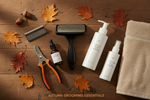
The Complete Autumn Dog Grooming Kit: What Every Owner Needs Before Winter
, 32 min reading time
, 32 min reading time
Discover how autumn changes a dog’s coat, skin and grooming needs. This complete guide covers seasonal shedding, brushing, bathing, drying, paw care, coat-specific tools and practical preparation for colder weather.
Autumn can be one of the most demanding seasons for a dog's coat, even though it rarely receives the same attention as spring shedding or winter paw care. The change happens gradually. Mornings become colder, daylight shortens, rain becomes more frequent, indoor heating starts running again, and suddenly a grooming routine that worked perfectly well in summer is no longer enough.
For many dogs, autumn also brings a noticeable coat transition. Double-coated breeds may release summer undercoat while preparing a denser winter coat. Long and curly coats begin collecting wet leaves, seeds and mud. Short coats may become duller or show dry skin more clearly once indoor air becomes warmer and less humid.
The answer is not simply to groom more often. Autumn grooming works best when the routine changes with the coat, weather and environment. The tools used in July may still have a place, but they may need to be supplemented with better drying equipment, more effective undercoat management, conditioning products, paw-care supplies and a more deliberate post-walk routine.
A well-built autumn grooming kit should therefore solve several problems at once: remove loose coat without damaging healthy hair, prevent wet fur from turning into mats, keep skin and coat comfortable as indoor conditions change, clean muddy paws efficiently, support proper drying and prepare the dog for colder weather ahead.
Autumn grooming is different because several environmental changes happen at approximately the same time. The coat may be changing while outdoor conditions become wetter and indoor conditions become drier. Those two environments create completely different grooming challenges, yet the dog moves between them every day.
There is also more variation between individual dogs than a simple seasonal calendar suggests. A dense double coat behaves differently from a fine silky coat, while a short smooth coat may need almost no detangling but still shed heavily. Age, activity, coat length, grooming history and time spent outdoors all influence what belongs in an effective autumn kit.
For that reason, the best approach is not to buy every grooming tool available. It is to understand what is changing and select tools that solve those specific problems. Most autumn grooming needs fall into a few clear categories.
The main seasonal challenges are:
Seasonal shedding is especially noticeable in dogs with a substantial undercoat. Coat cycles are influenced by several factors, including changes in daylight, genetics, environment and whether the dog spends most of its life indoors or outdoors. This means two dogs of the same breed may not begin or finish an autumn coat change at exactly the same time.
Indoor living can make the pattern less dramatic and more prolonged. Artificial lighting and stable indoor temperatures mean some dogs shed at a lower level throughout much of the year rather than producing two perfectly defined seasonal coat blows. Others still develop an obvious autumn period during which loose undercoat seems to appear almost faster than it can be brushed out.
The objective during this period is not to pull out as much hair as possible. Healthy guard coat should remain intact, and grooming should focus on coat that has already released naturally. Excessive use of aggressive de-shedding tools can irritate the skin or remove more healthy hair than intended.
During an active autumn coat change, useful grooming measures include:
A useful grooming kit is not defined by how many products it contains. Ten carefully selected tools that suit the dog's coat will usually be more useful than a cupboard full of equipment bought without a clear purpose. Autumn is a particularly good time to review the kit because the consequences of using the wrong brush or leaving the coat damp become more noticeable.
Some items are almost universal, while others depend strongly on coat type. A metal comb may be indispensable for a long-haired dog but unnecessary as the main tool for a very short smooth coat. An undercoat rake may transform the grooming routine of a heavy double coat while offering little value on a coat without substantial undercoat.
The kit should therefore be assembled in layers: basic hygiene and maintenance equipment first, then coat-specific tools, followed by seasonal additions for rain, mud, drying and paw care. This keeps the routine practical rather than unnecessarily complicated.
A comprehensive autumn kit may include:
A brush should be chosen according to coat structure, not simply according to the dog's size. A small long-haired dog may need a completely different brush from a much larger short-coated dog. Autumn makes this distinction particularly important because loose undercoat and moisture-related tangles can expose weaknesses in an otherwise adequate summer routine.
A good brush should reach the coat layer that actually needs attention without repeatedly scratching the skin. If a brush moves smoothly across the surface but leaves compacted coat underneath, it is not completing the job. On the other hand, using an unnecessarily aggressive tool simply because a dog is shedding can damage coat and make grooming uncomfortable.
Technique matters as much as the brush itself. Dense and long coats are usually easier to manage when divided into sections, allowing the brush to work through smaller amounts of hair. This also makes it easier to notice skin changes, small tangles and trapped debris before they become significant problems.
Common brush categories include:
A brush can create a misleading result. The surface may look smooth and beautifully arranged while small tangles remain close to the skin. This is particularly common behind the ears, in the armpits, around the collar area and where the legs meet the body.
A metal grooming comb is one of the simplest ways to check whether the coat has actually been brushed through. After brushing, the comb should move through the coat from near the skin toward the ends without repeatedly stopping. If it catches, there is usually more work to do in that section.
Autumn makes this check especially useful because damp hair and friction encourage tangles to tighten. A small knot found after a rainy walk can often be dealt with easily. The same knot left for several weeks may become a dense mat requiring far more work or even clipping.
Pay particular attention to:
Double coats require tools that can reach loose undercoat without unnecessarily cutting or damaging the protective outer coat. During an autumn coat transition, large amounts of released undercoat may remain trapped beneath the guard hair. If it is not removed gradually, it can compact and make the coat harder to clean, dry and maintain.
An appropriate undercoat rake can be very effective, but it should not be treated as a tool for endless hair removal. Stop when the coat is moving freely and the bulk of naturally released undercoat has been removed. Repeatedly working the same area after that point can create irritation and compromise the coat.
Bathing and professional-style drying can make the process considerably easier. Once the coat is clean and properly conditioned, controlled airflow can separate dense layers and move already released undercoat outward. This often reduces the amount of repetitive manual brushing required.
An undercoat-management routine may involve:
Autumn mud can create the temptation to reach automatically for the strongest cleansing shampoo available. That is not always the best approach. A coat that becomes dirty more frequently may actually require a product suitable for more regular use rather than increasingly aggressive cleansing.
Product choice should reflect the dog's skin and coat condition, how often bathing is necessary and what has actually contaminated the coat. A dog covered in ordinary wet soil after a walk presents a different cleaning problem from a heavily greasy coat. Using the strongest product for every bath can be unnecessary.
Concentrated professional shampoos should be diluted according to the manufacturer's directions. Correct dilution helps distribute product more evenly and makes thorough rinsing easier. Product residue left close to the skin is not a substitute for cleanliness and can make the coat feel heavy or uncomfortable.
When selecting an autumn shampoo, consider:
Conditioner becomes particularly useful on long, curly and friction-prone coats during wet weather. Its role is not simply to make the dog smell pleasant or feel soft. An appropriately selected conditioner can improve slip between hairs, make brushing easier and reduce the mechanical stress required to separate minor tangles.
This is especially useful when a coat is repeatedly exposed to rain, clothing, harnesses and towel drying. Each of those factors can increase friction. When combined with a longer coat, that friction can accelerate mat formation in areas that already receive frequent movement.
Conditioning still needs to suit the coat. A heavy formula may overwhelm a fine coat, while excessive softening may work against the desired texture of certain wire coats. More product does not automatically create a healthier or more manageable result.
Conditioner is particularly worth considering for:
A towel may be one of the least exciting pieces of grooming equipment, but in autumn it becomes one of the most frequently used. Dogs often return from outside with wet paws, legs, chest and belly even when they are not dirty enough to require a complete bath. Fast moisture removal can prevent that dampness from remaining in the coat unnecessarily.
For longer coats, blotting and squeezing are generally preferable to vigorous rubbing. Aggressive towel friction can twist wet strands together and contribute to tangling. The objective is to transfer water into the towel while disturbing the coat as little as possible.
Keeping more than one absorbent towel available is useful for larger or heavily coated dogs. Once the first towel is saturated, continuing to rub it over the coat achieves little. Replacing it with a dry towel can substantially reduce subsequent powered drying time.
Towels are useful for:
A dryer is not essential for every short-coated dog, but it becomes increasingly valuable as coat density and length increase. Dense double coats can feel dry on the surface while retaining significant moisture close to the skin. Curly coats can begin setting into uneven curls before they are completely dry, making later brushing and trimming more difficult.
High-velocity dryers remove water primarily through airflow rather than relying on intense heat. This is particularly effective for dense coats and seasonal undercoat removal. Variable speed is valuable because the appropriate airflow for the body may be far too strong around the face, ears or feet.
Dryer power should not be judged by wattage alone. Airflow, air velocity, nozzle design, motor configuration and adjustability all affect real-world performance. The best machine is one with enough capacity for the coat being dried and enough control to reduce intensity whenever necessary.
A dryer is particularly useful for:
Autumn paw care starts well before snow appears. Wet pavements, mud, grit, leaves and other debris can accumulate between pads and around the nails. Long-haired feet can retain even more moisture and dirt because the hair acts almost like a small mop.
A quick paw check after a wet walk can prevent a minor problem from becoming a grooming issue. Remove visible debris, clean dirty areas and dry between the pads. If the dog suddenly begins licking one paw repeatedly, examine it rather than assuming the behaviour is simply seasonal.
As colder weather approaches, local surfaces may also begin to contain grit or de-icing products. Where exposure occurs, paws should be cleaned after the walk rather than allowing residue to remain on the pads and later be licked off.
A practical paw-care station may contain:
Nail care remains important throughout the year, but autumn routines can change natural nail wear. Shorter daylight, wetter weather and less time on abrasive surfaces may mean that some dogs no longer wear their nails down as effectively as they did during summer. The change is gradual, so it can easily go unnoticed.
Nail length should be assessed according to the individual dog rather than by following an inflexible calendar. Growth rate, exercise surfaces, age and anatomy all affect how often trimming is required. Dewclaws deserve particular attention because they may receive little or no natural wear.
Both clippers and grinders can work well when used correctly. Some dogs tolerate the quick action of clippers better, while others prefer gradual grinding. Familiarity, control and regular maintenance are more important than declaring one method universally superior.
Check:
Autumn rain does not mean every dog suddenly needs frequent ear cleaning. It does mean that ears should be checked regularly, especially after bathing, swimming or repeated wet-weather activity. Dogs with hanging ears or substantial ear furnishings may retain moisture around the area longer.
A healthy-looking ear does not need aggressive cleaning simply because a bottle of cleaner is available. The purpose of routine inspection is to notice change. Strong odour, obvious discharge, persistent head shaking, redness or pain should not be treated as an ordinary grooming problem.
When cleaning is appropriate, use a product intended for canine ear care and follow its directions. Avoid inserting tools deep into the ear canal. Grooming should support normal hygiene, not attempt to treat an undiagnosed ear condition.
During autumn checks, look for:
Double-coated dogs often require the greatest seasonal adjustment. Their dense undercoat can release heavily, while the outer guard coat continues performing its protective function. The goal is to remove loose material without stripping away healthy coat.
Work in sections and pay attention to areas where undercoat becomes particularly dense, such as the neck, trousers, shoulders and tail base. Bathing followed by controlled high-velocity drying can be extremely effective during a major coat release. The coat should then be checked manually and brushed after drying.
Avoid assuming that shaving is the solution to seasonal shedding. Cutting hair shorter does not stop the biological shedding process. Unless there is a specific medical or exceptional grooming reason, seasonal coat management should focus on maintaining the natural coat rather than removing it.
An autumn kit for a double coat may include:
Short coats are easier to dry and do not develop traditional mats, but that does not make them maintenance-free. Short hairs can shed extensively and become embedded in upholstery and clothing. Skin changes are also more visible because there is less coat covering them.
A rubber curry or grooming mitt can be more useful than a fine slicker for many smooth coats. It lifts loose hair while providing broad contact rather than repeatedly scratching exposed skin. During heavy shedding, short regular sessions are usually better than aggressive attempts to remove everything at once.
Mud is often the larger autumn problem. Because these coats dry relatively quickly, local cleaning of the paws, legs and belly may be enough after many walks. Full shampoo baths can then be reserved for when the entire coat genuinely needs cleaning.
Long coats require an autumn strategy built around friction and moisture control. Wet hair sticks together, harnesses move against it, leaves become caught in furnishings and towel drying adds another source of friction. Small tangles can therefore appear surprisingly quickly.
Brush in sections and follow with a metal comb. Do not repeatedly drag a brush through a tight knot from the root. Work from the outer portion of the tangle while supporting the hair closer to the skin to reduce pulling.
Conditioning becomes particularly useful for these coats. A suitable rinse-out conditioner or grooming spray can improve slip and reduce the mechanical effort required during brushing. Complete drying after a bath or very wet walk is equally important.
Curly coats can hide tangles exceptionally well. The surface may look soft and fluffy while compacted hair is developing closer to the skin. Autumn moisture makes this more difficult because curls can tighten around small tangles as the coat dries.
Line brushing followed by a comb check is one of the most reliable maintenance methods. The coat should be divided into manageable sections rather than brushed randomly over the surface. Areas under harnesses, behind ears, around legs and in the armpits deserve particular attention.
After bathing, controlled drying can straighten and separate the coat before clipping or scissoring. Even when no haircut is planned, complete drying makes it easier to confirm that the coat is free from hidden tangles.
Wire coats require a different objective because excessive softening is not always desirable. The traditional texture is firmer than that of a silky or curly companion coat. Product selection and drying should therefore respect the desired finish.
Some wire coats are maintained by hand-stripping, while others are clipped for practical pet grooming. Those techniques create different long-term results, so autumn is not a reason to change the established coat-management method without understanding the consequences.
Beards and leg furnishings may collect significant mud and moisture even when the body jacket remains relatively clean. Local cleaning, combing and complete drying of these areas can reduce the need for unnecessary full baths.
A puppy experiencing its first autumn is learning far more than how to tolerate a brush. Wet paws, towels, dryers, nail tools and longer indoor grooming sessions may all be new experiences. The priority should be building a calm routine rather than completing every procedure perfectly.
Keep sessions short and introduce one challenge at a time. A puppy that accepts a towel calmly today can learn about a dryer at low speed tomorrow. Trying to perform a full adult grooming routine in one long session may create unnecessary resistance.
Coat changes can also occur as puppy hair develops toward an adult coat. In some longer and curly coat types, this transition can temporarily increase tangling. Grooming frequency may therefore need to increase even though the dog is still young.
Useful puppy priorities include:
Healthy adult dogs usually allow the grooming routine to be based primarily on coat and lifestyle. A highly active dog walking through woodland every day may require much more post-walk maintenance than a dog of the same breed spending most outdoor time on clean urban paths.
Autumn is a good time to stop following a fixed grooming calendar blindly. Instead, inspect the coat regularly and adjust frequency according to what is happening. Heavy shedding may require several brushing sessions one week and far fewer a month later.
The same applies to bathing. Muddy weather may create a need for more frequent local cleaning, but that does not automatically mean a complete shampoo bath after every wet walk. Targeted cleaning can often maintain hygiene while keeping the overall routine manageable.
Older dogs may need exactly the same coat maintenance as younger dogs but delivered differently. Standing for a long period can become uncomfortable, and colder weather may make existing stiffness more noticeable. A routine that was easy several years ago may now need to be divided into shorter sessions.
Non-slip surfaces become increasingly important. Allow comfortable sitting or lying where the grooming task permits it, and avoid repeatedly repositioning the dog simply to achieve a cosmetically perfect angle. Comfort should take priority over speed.
Senior skin can also become more delicate, making aggressive brushing increasingly inappropriate. Any sudden hair loss, unusual lumps, persistent itching, painful areas or major changes in coat condition deserve appropriate professional assessment rather than simply stronger grooming.
Useful modifications include:
One of the most effective autumn grooming habits happens outside the formal grooming session. A few minutes immediately after a wet or muddy walk can prevent much longer work later. This is particularly true for long, curly and heavily furnished coats.
Do not automatically brush a coat while it is soaked and covered in mud. Remove debris carefully, rinse areas that genuinely need rinsing and absorb excess water first. Once the coat is clean enough and at an appropriate stage of drying, it can be brushed according to its type.
Use the same order each time so that the routine becomes predictable. Consistency also makes it easier to notice changes, such as a new sore paw, damaged nail or sudden sensitivity in one area.
A simple routine is:
Winter grooming problems are often created weeks before winter begins. Nails gradually become too long, paw care is postponed, dense undercoat compacts and small tangles remain unnoticed under collars or behind ears. By the time snow and road treatments arrive, the routine is already playing catch-up.
Late autumn is therefore the ideal time to inspect the entire grooming kit. Replace worn brushes, check clipper and dryer condition, sharpen or replace nail tools if necessary, wash grooming textiles and make sure frequently used products are still within their usable period.
It is also worth reassessing the coat itself. A long coat that enters winter free from mats is much easier to maintain than one already carrying several weeks of accumulated tangles. Healthy coat should be prepared for winter, not stripped away simply for convenience.
Before the first frost, check:
Most seasonal grooming problems do not result from complete neglect. They usually develop because a summer habit continues after conditions have changed. A brush that worked once a week in dry weather may not be enough when a long coat is repeatedly getting wet.
Another common mistake is trying to solve every problem by adding more product. More shampoo does not compensate for incomplete rinsing, and more conditioner does not remove an established mat. Good technique should come before additional cosmetics.
Finally, autumn grooming should not become a competition to remove the greatest possible amount of hair. Seasonal shedding is normal, but healthy coat still has a function. Grooming should remove what has released and maintain what remains.
Avoid:
Many dogs experience seasonal changes in their coat as daylight patterns change and the coat transitions toward winter. This is particularly visible in double-coated breeds, where loose undercoat can appear in substantial amounts over a relatively short period.
Indoor living can make shedding patterns less predictable, so not every dog will experience one dramatic autumn coat blow. Some shed moderately over a longer period instead.
There is no universal frequency. Short smooth coats may need only one or two brief sessions each week, while a double coat in active seasonal shedding may benefit from much more frequent attention.
Long and curly coats should be checked according to how quickly they tangle, particularly after wet walks. The correct frequency is the one that prevents loose coat and small tangles from becoming larger problems.
Not automatically. A dog walking through mud every day may need more cleaning, but many of those clean-ups can be limited to paws, legs, belly and chest rather than requiring a complete shampoo bath.
When full bathing is needed, choose products appropriate for the coat and expected frequency of use. Thorough rinsing and complete drying matter as much as the bathing interval itself.
The best brush depends on coat type. A rubber curry may be ideal for a smooth short coat, while an appropriate undercoat rake can be much more effective on a dense double coat.
Long and curly coats often require a slicker or pin brush followed by a metal comb. The objective is not to find one universal shedding brush but to match the tool to the structure of the coat.
Many long, curly and friction-prone coats benefit from conditioning during wet weather. Conditioner can improve slip and make routine brushing easier, especially when the coat is repeatedly exposed to rain, towels, harnesses and clothing.
Not every coat requires a heavy conditioning formula. Product choice should reflect coat texture and the intended finish.
Prevent the coat from remaining wet for long periods, remove outdoor debris promptly and concentrate brushing on high-friction areas rather than only the easy-to-reach back. A comb check after brushing is particularly useful for long and curly coats.
Small tangles are easier to manage than mature mats. Regular maintenance therefore reduces both grooming time and discomfort.
Routine shaving is generally not the appropriate response to normal seasonal shedding. Double coats consist of an outer protective layer and an insulating undercoat, and shortening the hair does not stop the biological shedding cycle.
Instead, focus on appropriate de-shedding, bathing, drying and brushing. Exceptional medical or severe matting situations should be evaluated individually.
Remove visible debris first, then rinse with clean water when mud or contaminants need to be washed away. Dry carefully, including between the pads, and inspect for small foreign objects or damage.
A full-body bath is rarely necessary simply because the feet are dirty. A dedicated paw-cleaning routine is faster and often more practical.
First check whether the coat is genuinely dry close to the skin. Dense undercoat, ears, feet and heavy furnishings can retain moisture even when the surface appears dry.
Persistent or unusual odour may also originate from the skin, ears, mouth or another source rather than the coat itself. Recurring strong odour accompanied by redness, discharge, itching or discomfort deserves further assessment rather than repeated bathing.
Normal seasonal shedding should not create inflamed skin, obvious pain, large bald patches, wounds or severe persistent itching. Grooming can reveal these changes, but it cannot diagnose their cause.
Seek veterinary advice when coat changes are sudden or accompanied by significant skin abnormalities, pain, repeated ear problems, unexplained hair loss, persistent paw licking or other signs suggesting that the problem extends beyond routine grooming.
The best autumn routine is not necessarily the most elaborate one. It is the routine that can be repeated consistently and catches small problems early. Ten minutes of targeted grooming several times a week can be far more useful than a long session once a month.
Start with the coat. Identify whether the main challenge is shedding, tangling, moisture, mud or a combination of several factors. Then build the routine around that problem rather than copying a generic schedule designed for a completely different coat.
Finally, adjust the routine as autumn progresses. September conditions may be very different from late November. The grooming kit should remain the same foundation, but the frequency with which individual tools are used can change.
A practical autumn rhythm can include:
Autumn grooming is really about transition. The coat is moving away from summer conditions while the environment becomes wetter outdoors and drier indoors. Waiting until winter to respond means many of the most preventable problems have already had weeks to develop.
A well-designed grooming kit makes this transition considerably easier. The correct brush manages the coat rather than fighting it. A comb catches hidden tangles. Appropriate shampoo and conditioner support efficient bathing, while absorbent towels and proper drying prevent moisture from lingering in dense or long hair.
Paw and nail care complete the routine because autumn grooming should never focus on coat alone. Mud, debris, wet surfaces and changing exercise patterns all affect the lower part of the dog long before the first snow arrives.
Most importantly, the routine should remain individual. Coat type, age, activity and actual condition matter more than a fixed seasonal checklist. The purpose of the kit is not to use every tool every week; it is to have the correct tool available when the coat tells you it is needed.
That is what good seasonal grooming looks like: less emergency correction, fewer preventable tangles, better coat preparation and a smoother transition into winter.
At Groomica, we believe effective grooming begins with understanding the coat before choosing the tool. A slicker brush, undercoat rake, conditioner or dryer can be extremely useful when it solves the right problem, but no single product is suitable for every coat, season or grooming routine.
Groomica.eu brings together professional grooming equipment, coat-care solutions and practical knowledge for everyday maintenance and professional grooming environments. Our focus is not simply on individual products but on how bathing, brushing, drying, detangling, coat maintenance and hygiene work together as one complete system.
Seasonal grooming is a good example of why this matters. Autumn may require stronger undercoat management for one dog, better detangling and conditioning for another, and little more than efficient paw cleaning and regular short-coat brushing for a third. The right routine starts with recognising those differences.
At Groomica, our approach focuses on:
A successful autumn grooming kit is not the largest one. It is a carefully selected collection of tools that makes regular maintenance easier, keeps the coat manageable and prepares the dog for the colder months ahead.


